
General managers constantly juggle sales, service, and finance conversations that arrive via phone, email, and text. When each channel lives in a separate inbox, responses slip, appointments are missed, and revenue leaks. The rise of AI-driven omnichannel messaging offers a way to bring every interaction into a single view, turning fragmented chatter into coordinated action. This guide walks a general manager through the concepts, criteria, and steps needed to pick a platform that can streamline workflows, boost customer experience, and drive growth.
Why AI-powered communication matters for dealerships
Fragmented communication creates delays: a sales lead texts a prospect, the service team receives a voicemail, and the finance desk logs an email, each separate and each vulnerable to human error. Those gaps chip away at trust and push potential buyers toward competitors. An AI-driven omnichannel platform simplifies texting, voice messaging, review management, and payment tools, allowing staff to respond from one place. This integration supports SMS marketing, mass texting, and appointment reminders while maintaining compliance and data integrity. A TCPA (Telephone Consumer Protection Act) compliance guide highlights the importance of consent management when automating outreach.
When a dealership can send targeted texting campaigns and capture real-time feedback, it builds a richer view of each customer's journey. AI can prioritize leads, suggest the best time for a service call, and even process text payments without manual entry. The result is a smoother handoff between sales and service, fewer missed appointments, and a higher likelihood that a prospect moves from inquiry to purchase. Service automation further reduces manual data entry, freeing staff to focus on relationship building rather than paperwork.
To start, map every communication touchpoint in your dealership and note where delays occur. Identify which interactions could benefit from AI-driven routing, such as lead follow-up texts or service reminders. Prioritize the areas that most directly affect revenue and customer satisfaction, then evaluate platforms that address those gaps.
Recommended read: 3 Tips to Maximize your Dealership from Anywhere with Motility & Kenect - A concise playbook for extending dealer outreach through integrated texting and dealer management system (DMS) workflows.
Key criteria to evaluate an AI communication platform
Choosing the right solution begins with a clear set of criteria. Integration ease comes first; the platform must sync with your existing DMS and Customer Relationship Management (CRM) system without extensive custom coding. Compliance features ensure that SMS marketing and text payments meet TCPA and state regulations. Robust analytics provide visibility into campaign performance, response rates, and revenue impact. Finally, scalability determines whether the tool can grow as you add locations or increase message volume.
The table below outlines a practical evaluation framework. Each row lists a criterion, why it matters for a dealership, and a quick check you can perform during a demo.
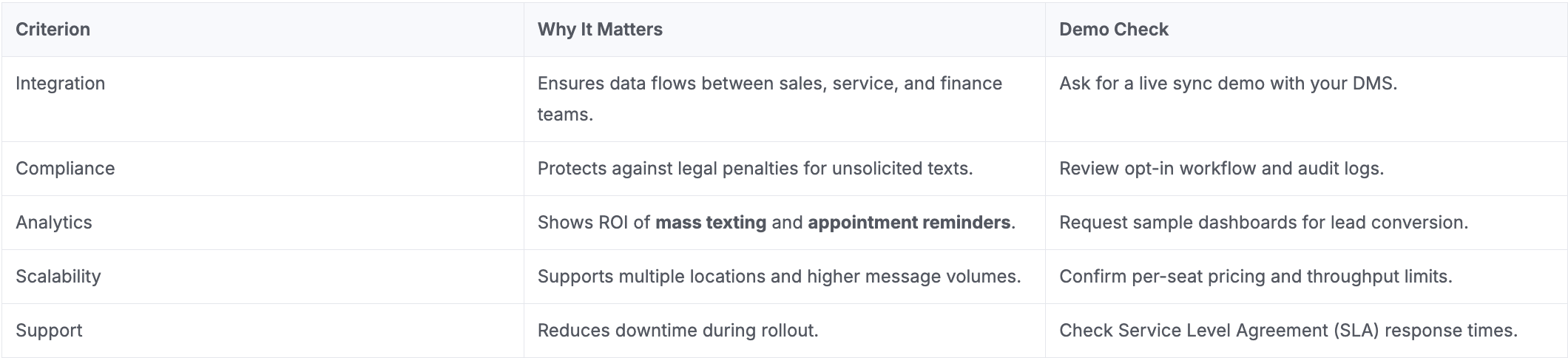
These rows help you compare vendors quickly and keep the evaluation focused on operational impact rather than feature lists.
Assign a weight to each criterion based on your dealership's priorities. For example, integration may be 40% of the score if your DMS is mission-critical. Run a pilot in one location, measure the results against your weighted scorecard, and then decide whether to scale. This systematic approach minimizes risk and ensures the chosen platform aligns with both technology and business goals.
Recommended read: How Karl Malone Powersports Scaled Customer Communication with AI – Not More Staff - Demonstrates how an AI-enabled platform can handle higher volume without adding headcount.
Integrating communication tools with dealership workflows
Effective integration starts with mapping the dealer's core processes: lead capture, appointment scheduling, service follow-up, and payment collection. An AI platform should embed appointment reminders directly into the service calendar, trigger review management requests after a job is completed, and enable text payments that update the finance system in real time. This reduces the manual steps staff currently perform, such as copying a phone number from a text into the DMS.
When the platform captures a customer's response, it feeds that data back into the CRM, creating a single source of truth for each interaction. Real-time feedback loops allow managers to see which SMS marketing messages generate replies and which mass texting campaigns drive service bookings. A recent market report on dealership digital transformation shows that integrated workflows are a key driver of operational efficiency.
Begin integration by selecting a pilot department - often service, because appointment reminders and text payments have immediate impact. Configure the platform's API to push and pull data from the DMS, test end-to-end flows, and train staff on the new tool. Once the pilot proves reliable, extend the integration to sales and finance, ensuring each team benefits from a unified communication hub.
Recommended read: 5 Reasons Businesses Use Text-to-Pay - Explores how text-based payment collection can streamline dealer cash flow.
Measuring impact on customer experience and revenue
Without clear metrics, it's impossible to know whether a new platform delivers value. Dealerships should track both quantitative and qualitative indicators. For SMS marketing, track delivery rates, response rates, and conversion to showroom visits. For appointment reminders, measure decrease in no-shows and increase in service lane usage. Review management should be evaluated by the volume of new reviews and average rating trends.
Qualitative feedback, such as customer comments captured through post-service surveys, adds context to the numbers. AI can gather sentiment from text replies, highlighting common praise or pain points. A study on AI in dealership back-office operations emphasizes that combining hard data with sentiment analysis yields a fuller picture of performance.
Set up a dashboard that pulls data from the communication platform and your DMS, updating daily. Review the dashboard weekly to spot trends, adjust messaging cadence, and refine targeting. Continuous improvement loops ensure the platform remains aligned with revenue goals and customer expectations.
Practical checklist for the final decision
Before signing a contract, run through this concise checklist to confirm the platform meets your dealership's needs:
- Does the solution integrate natively with your DMS and CRM?
- Are compliance features built-in for SMS marketing and text payments?
- Can you view real-time analytics for mass texting and appointment reminders?
- Is the platform scalable across multiple locations?
- Does the vendor provide a clear pilot roadmap and support SLA?
Assign a pass/fail rating to each item, prioritize any gaps, and discuss mitigation plans with the vendor. If the majority of items receive a pass, you have a strong candidate ready for rollout.
Finally, schedule a stakeholder meeting to align on rollout timelines, training schedules, and success metrics. With a clear plan in place, your dealership can move from fragmented outreach to a coordinated, AI-enhanced communication engine.
FAQs
1. How can a dealership improve response times without adding staff?
By deploying an AI-driven omnichannel platform that routes inbound texts and calls to the right team member, you eliminate the need for manual work. Features like appointment reminders and text payments also reduce back-and-forth exchanges, allowing staff to focus on high-value interactions rather than repetitive follow-ups.
2. What should be considered when choosing between SMS marketing and mass texting solutions?
Evaluate the level of personalization each option offers. SMS marketing typically supports targeted, one-to-one messages with dynamic content, while mass texting is better for broad announcements. Consider compliance capabilities, deliverability rates, and how each integrates with your existing CRM to ensure consistent messaging.
3. How does review management integrate with existing dealership systems?
A modern platform can push review requests automatically after a service is completed and sync the ratings back into the DMS. This creates a single view of customer sentiment, enabling managers to address negative feedback quickly and showcase positive reviews.
4. What compliance issues should be addressed for text payments and appointment reminders?
Both channels fall under the TCPA. Ensure you have documented opt-in consent for each customer, provide clear opt-out instructions in every message, and maintain audit logs that prove compliance. Working with a platform that automates consent tracking simplifies this process.
5. How can service automation be scaled across multiple dealership locations?
Start with a pilot at a single site to fine-tune workflows and integration points. Once proven, replicate the configuration using the platform's central dashboard, adjusting settings for each location's staffing and volume. Consistent reporting across sites ensures you can track performance and make data-driven adjustments.
Conclusion
Fragmented communication is a hidden cost that decreases revenue and frustrates customers. By adopting an AI-driven omnichannel platform, dealerships can unify texting, voice, review, and payment interactions, creating a seamless experience that supports sales, service, and finance teams. Use the criteria, integration steps, and measurement practices outlined above to evaluate vendors objectively and select a solution that fits your operational needs. Applying these principles will help you streamline workflows, improve customer satisfaction, and position your dealership for sustained growth.
Recommended authority resources
- Reference: TCPA compliance: Requirements, rules and penalties - Provides detailed guidance on text‑based outreach compliance for U.S. businesses.
- Reference: Dealership Digital Transformation Services Market Size, Share & Industry Analysis - Offers market size and growth forecasts for AI‑driven dealership solutions.
- Reference: How AI in car dealerships is reshaping back‑office operations - Highlights operational benefits of AI automation in dealership environments.